
Stop Taping Sensors: Fabric Noise Beats Rigid by 80%
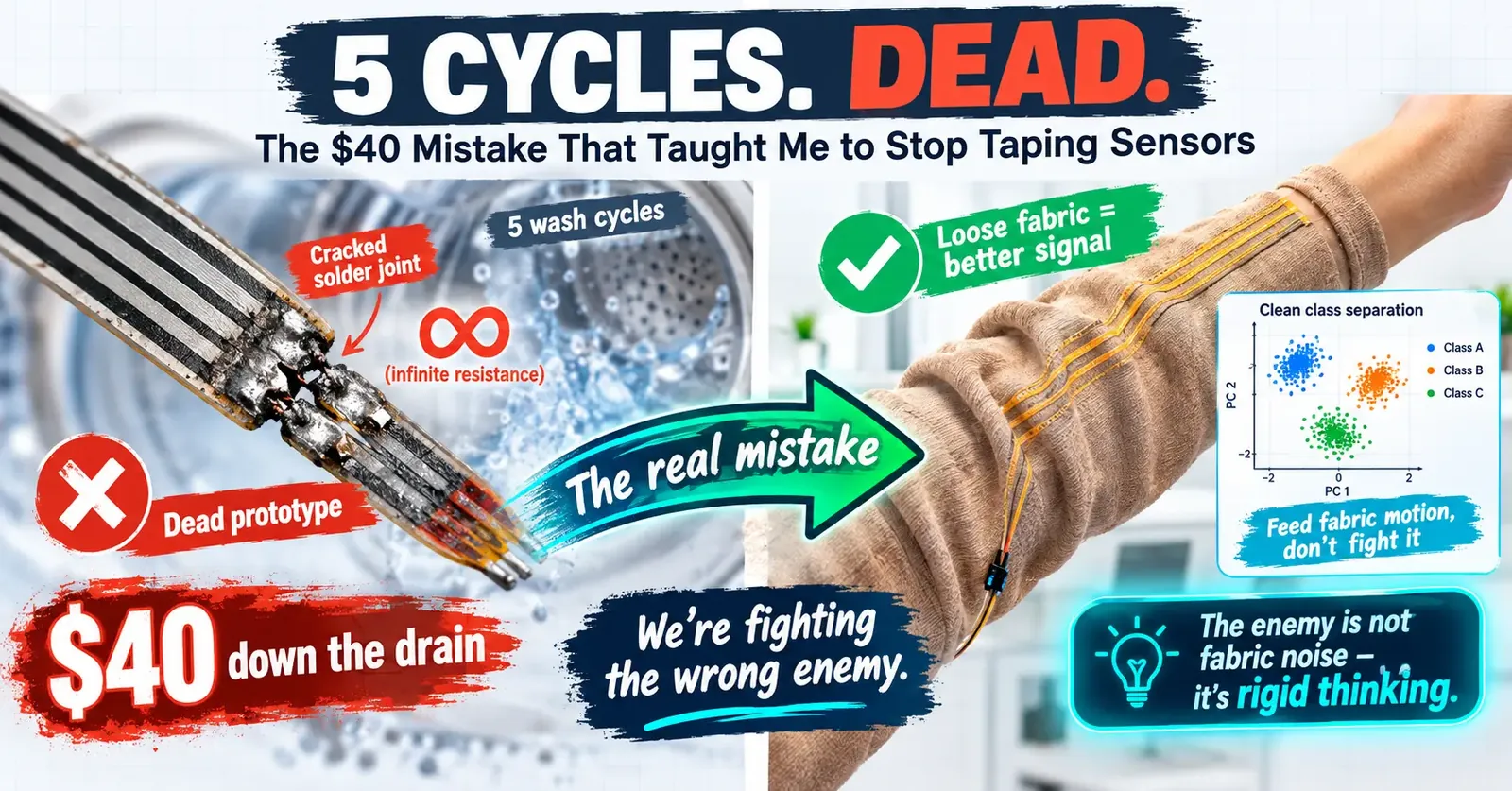
I ruined a $40 flex sensor prototype in the wash last year. Just forgot to take it out of my pocket. The solder joint cracked at the flex point, resistance shot to infinity, and the whole thing was done. Five cycles. Dead.
That failure pushed me down a rabbit hole on washable e-textiles, and what I found genuinely surprised me. Not just about durability — but about a bigger mistake most of us are making right from the hardware design stage.
We're fighting the wrong enemy.
The Signal You've Been Throwing Away
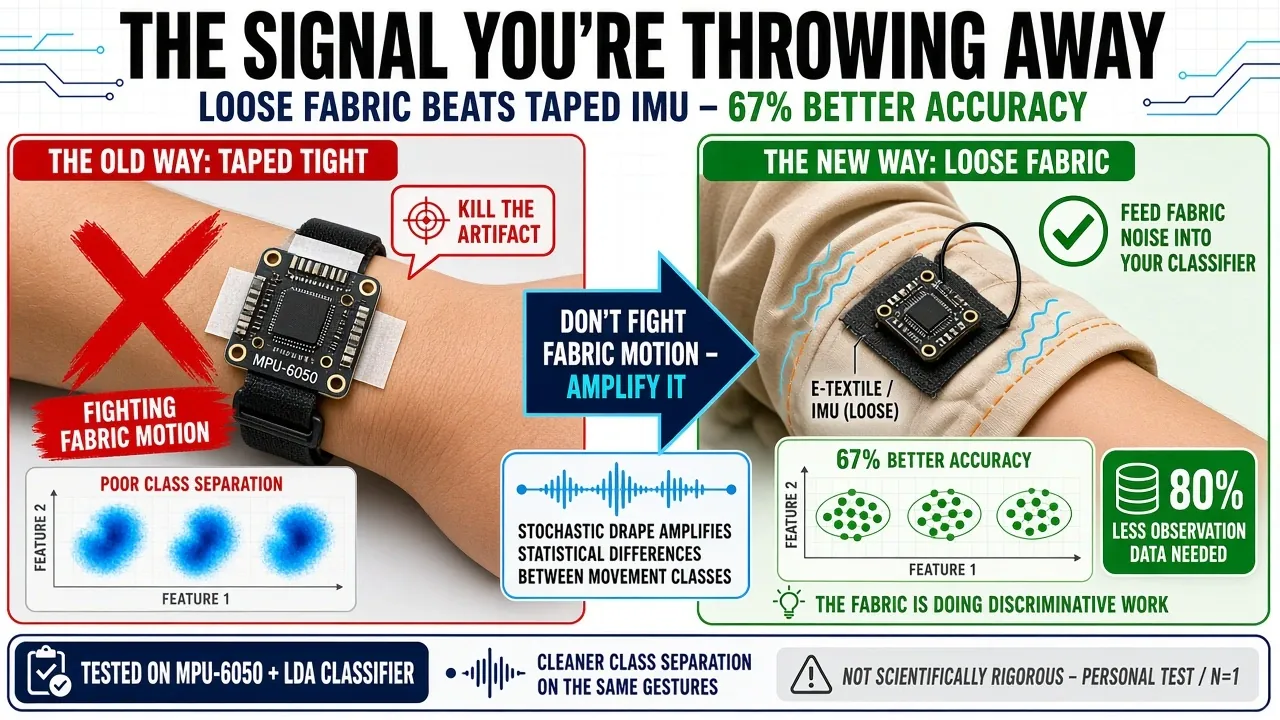
Here's what I didn't expect: that baggy sleeve on your test subject isn't a problem. It's actually your best feature extractor.
Most motion classification guides tell you to tape your IMU tight to the wrist or arm. Reduce fabric movement. Kill the artifact. I did this too — little bits of medical tape, velcro straps, the works.
Turns out that's exactly backwards.
Research shows that loose-fitting clothing sensors improve activity recognition accuracy by up to 67% at short 0.5-second time windows, and they need ~80% less historical observation data to make that prediction. Why? Because the stochastic drape of loose fabric amplifies the statistical difference between movement classes. The fabric is doing discriminative work your signal processor would otherwise need more time to figure out.
I tested this on my MPU-6050 setup, just strapping the module to my sleeve instead of my wrist. The LDA classifier I was using got noticeably cleaner class separation on the same gestures. Not scientifically rigorous on my end, but the pattern was obvious.
Don't fight fabric motion. Feed it into your model.
Why I Stopped Using Silver Ink (And You Should Too)
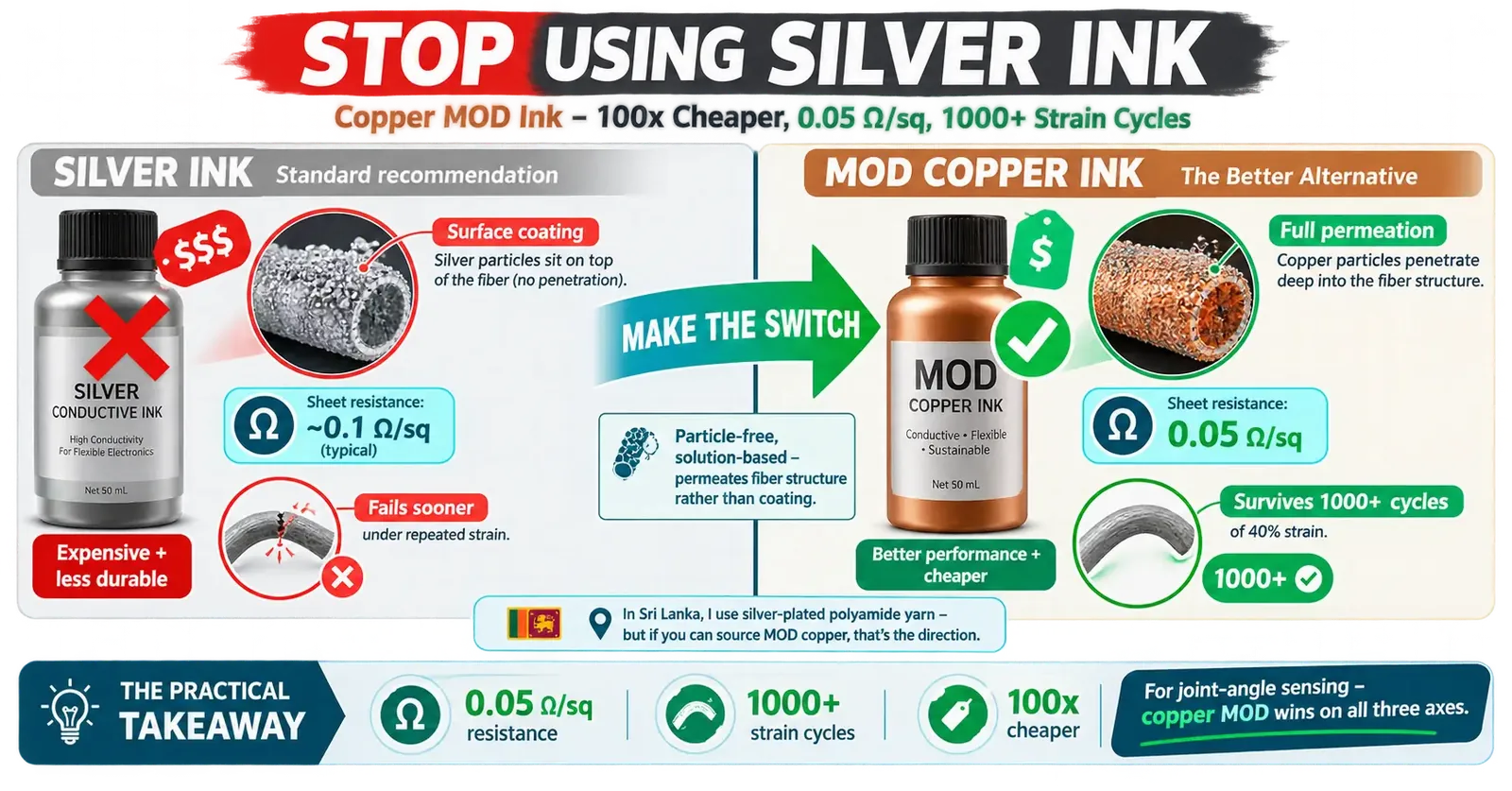
Silver conductive ink is the standard recommendation. It's also expensive enough that I had to budget two months of side-project income to buy one bottle when I was starting out.
There's a much cheaper alternative that actually works better for stretchable fabrics: metalorganic decomposition (MOD) copper ink.
These are particle-free, solution-based inks that fully permeate the fiber structure rather than coating the surface. After electroless plating for about 60 minutes, you get a sheet resistance of 0.05 Ω/sq. That's lower than most silver ink products. And it survives over 1,000 cycles of 40% strain stretching.
The cost? About 100 times cheaper than silver.
I haven't had access to MOD ink directly — I'm still working with what I can source here in Sri Lanka, which is mostly silver-plated polyamide yarn. But if you can get the copper MOD setup, that's the direction I'd go. The strain endurance alone makes it worth it for any joint-angle sensing application.
The Sensing Material That Changed My Perspective
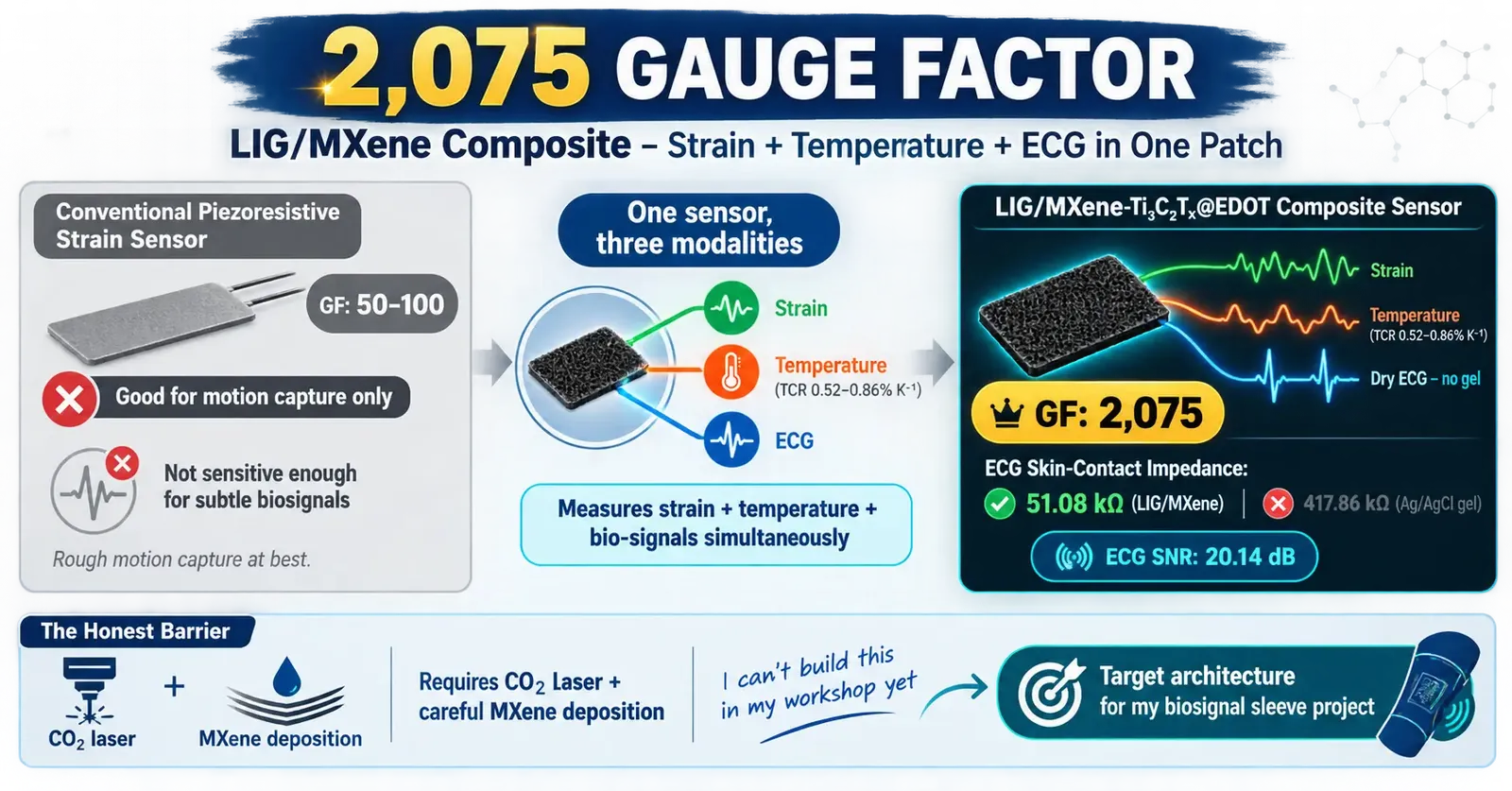
I thought piezoresistive strain sensors maxed out somewhere around a gauge factor of 50 or 100. Good enough for rough motion capture. Not great for subtle biosignals.
Laser-induced graphene / MXene composites are a different story entirely.
The LIG/MXene-Ti₃C₂Tₓ@EDOT composite sensors published in recent research deliver a gauge factor of 2,075 at strains above 22%. That's not a typo. Two thousand and seventy-five. On top of that, they also function as dry ECG electrodes with a skin-contact impedance of 51.08 kΩ at 10 Hz — compared to 417.86 kΩ for standard clinical Ag/AgCl gel electrodes. And they pull off an ECG signal-to-noise ratio of 20.14 dB.
A single sensor patch that measures strain, temperature (TCR of 0.52–0.86% K⁻¹), and bio-signals at the same time. Without gel.
I can't build these in my workshop yet. The fabrication requires a CO₂ laser and careful MXene deposition that's outside what I can do right now. But I'm using this as my target architecture for a biosignal sleeve project I'm planning.
The Wash Cycle Problem Nobody Talks About Honestly
This is where I see the most overconfidence in hobbyist e-textile projects, including my old ones.
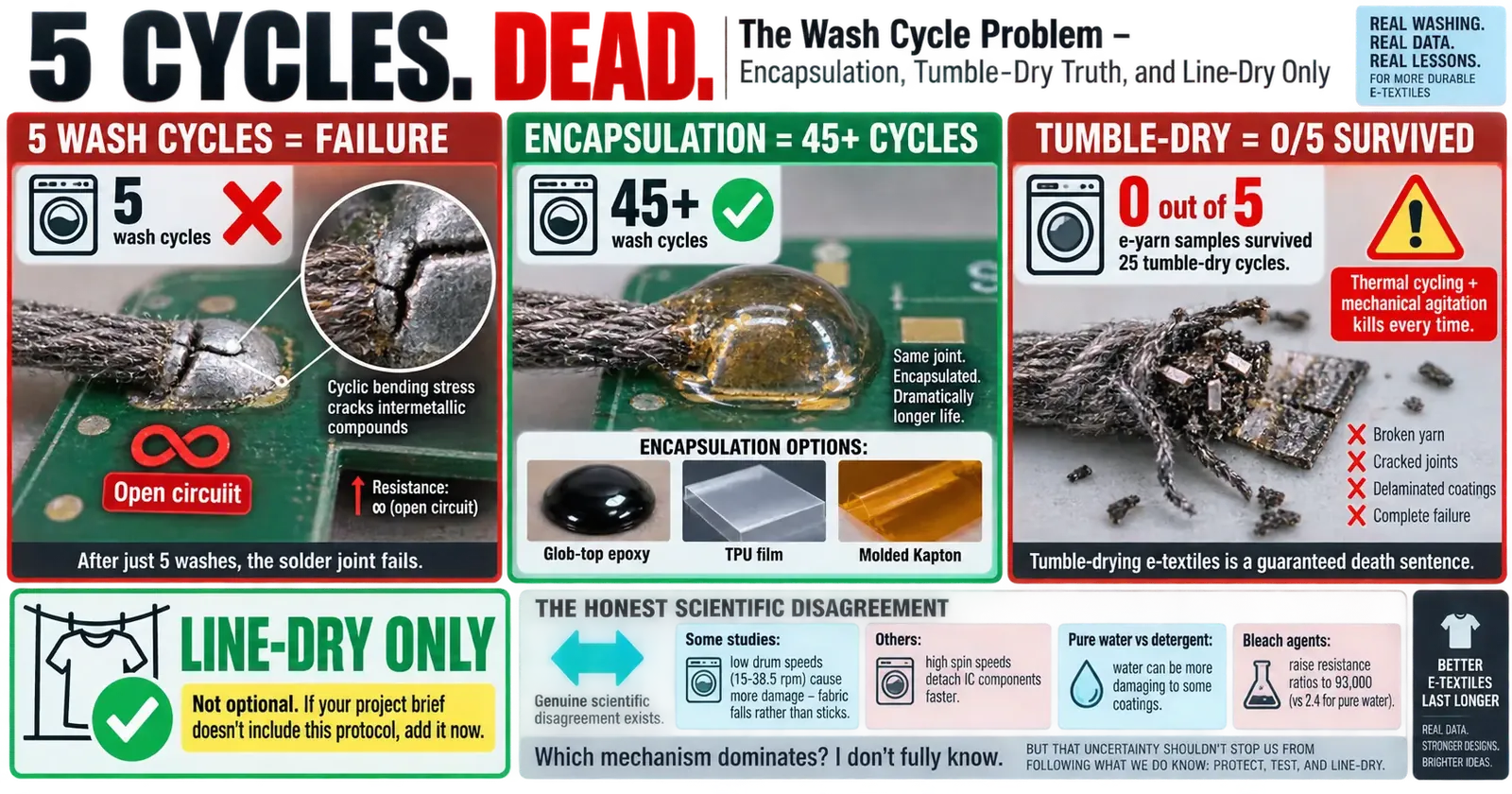
Conductive yarn sewn to a PCB pad looks fine on day one. After five washes? The intermetallic compounds at the solder joint start cracking from cyclic bending stress. The track resistance climbs. Then it's open circuit.
Unencapsulated solder joints fail after about 5 domestic wash cycles. Glob-top epoxy, TPU film, or molded Kapton over the junction extends that to 45+ cycles.
And here's the one that shocked me: 0 out of 5 e-yarn samples survived 25 tumble-dry cycles. Not some. None. The thermal cycling combined with mechanical agitation just kills them every time.
Line-dry only. Not optional. If your project brief doesn't include this protocol, add it now.
But also — there's genuine scientific disagreement here that I want to be upfront about. Some studies show that low drum speeds (15–38.5 rpm) cause more physical damage than high speeds, because the fabric keeps falling rather than sticking to the drum wall. Other studies show the opposite — that high spin speeds detach IC components faster. Pure water immersion turns out to be more damaging to some coatings than detergent solution, while other papers show bleach agents raise resistance ratios to over 93,000 compared to 2.4 for pure water alone.
I honestly don't fully understand yet which mechanism dominates for a given conductor type. If you've done real wash-cycle characterization in your own lab, I'd genuinely like to hear what you found.
Free Energy From Walking?
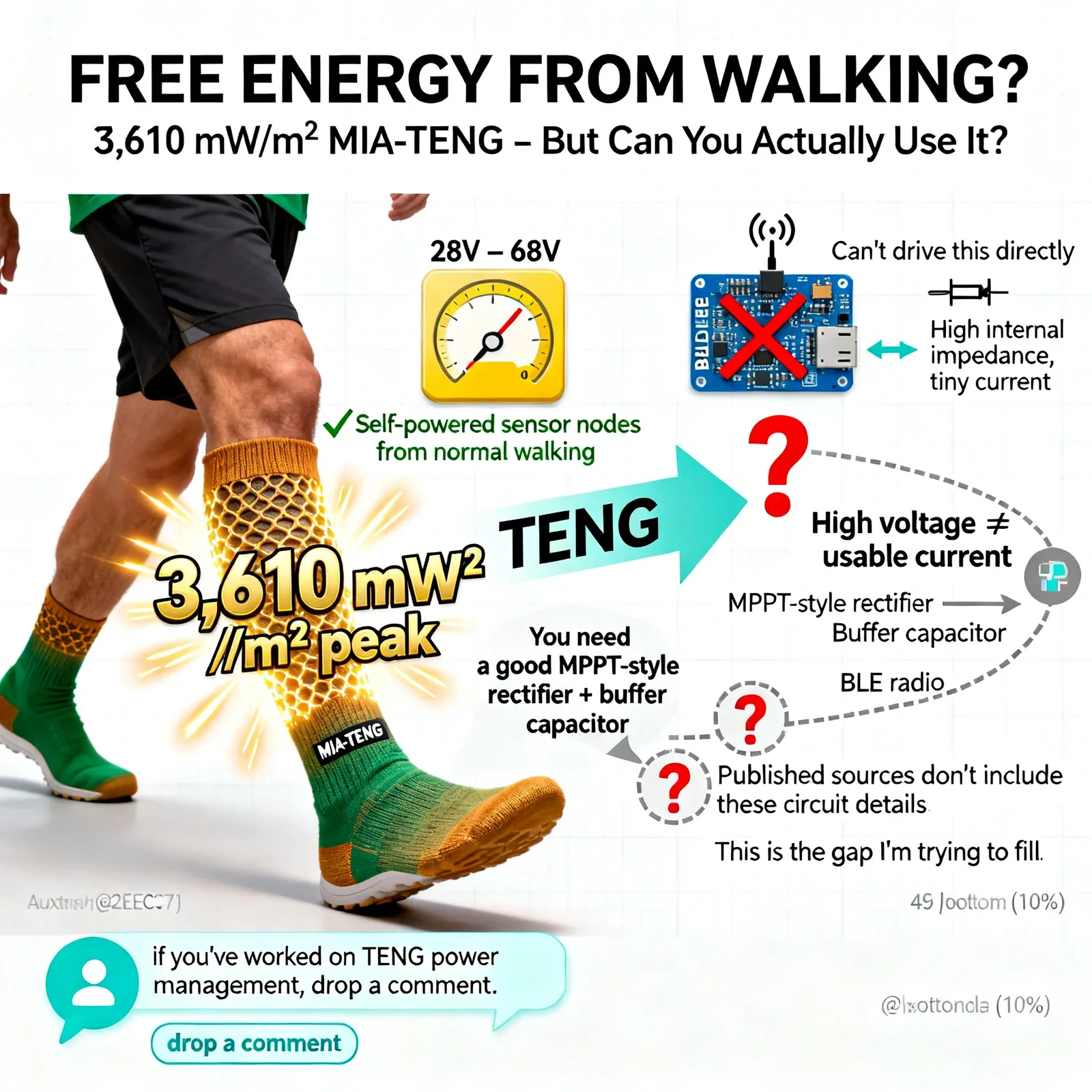
One more thing worth mentioning: triboelectric nanogenerators built into auxetic textile structures (MIA-TENGs) can generate a peak power output of 3,610 mW/m², with output voltages between 28 V and 68 V depending on how hard the fabric is pressed.
That's enough to think seriously about self-powered sensor nodes that harvest energy from normal walking movement.
You're probably wondering... "28 volts from a sock?" The open-circuit voltage is high, yes, but the internal impedance is also high and the current is tiny. You'd need a good MPPT-style rectifier and a buffer capacitor before you can drive anything useful like a BLE radio. The published sources don't include those circuit details, which is the gap I'm still trying to fill. If you've worked on TENG power management, drop a comment. Seriously.
What I'd Do
Start with the basics:
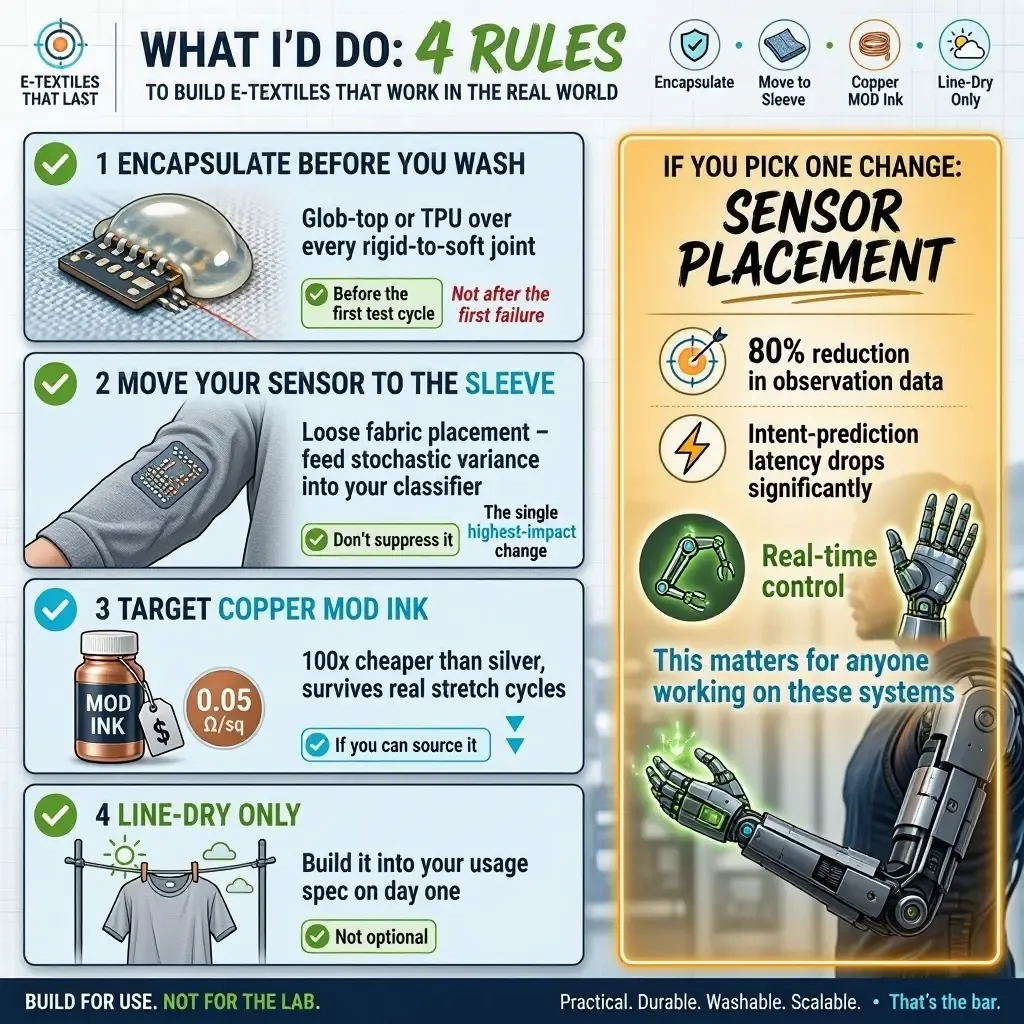
- Encapsulate before you wash. Glob-top or TPU over every rigid-to-soft joint, before the first test cycle. Not after the first failure.
- Move your sensor to the sleeve. Loose fabric placement, not taped-to-skin. Feed the stochastic variance into your classifier, don't suppress it.
- Target copper MOD ink if you can source it. 0.05 Ω/sq, 100x cheaper than silver, and it survives real stretch cycles.
- Line-dry only. Build it into your usage spec on day one.
If I had to pick one change from everything above, it's the sensor placement. The 80% reduction in required observation history means your intent-prediction latency drops significantly — which directly matters if you're doing real-time exoskeleton or prosthetic control.
That's a huge deal for anyone working on those systems.
Are you building something with e-textiles right now, and have you actually tested your design through a full wash cycle? Let me know in the comments — I want to compare notes.