
Significant breakthroughs in tactile transmission systems have substantially enhanced the accuracy and dependability of remotely performed clinical procedures, marking a paradigm shift.
By removing force feedback, operators lose essential sensory information, rendering them functionally impaired and reliant on visual cues alone. The absence of explicit visual signals forces surgeons to depend solely on tactile inputs, thereby amplifying the likelihood of errors. Vision tells you that tissue deformed. Touch tells you how much force caused it, which is the information that actually guides how hard you push next.
Creating haptic feedback for medical teleoperation systems poses significant challenges due to the need to recreate the tactile sensation in real-time over a distant connection, often at odds with the expectations set by industry standards. The biological receiver is sophisticated, the bilateral control system has to maintain stability under communication delay, and the physical sensing hardware has to function reliably in an environment that periodically runs through a 134-degree-Celsius autoclave cycle. Getting all three layers right simultaneously is the actual engineering challenge this article covers.
The Biology You Are Engineering Against
The effectiveness of a haptic system depends on grasping how the human sensory system functions and its limitations, because mistakenly aiming at specific receptors can lead to distorted tactile signals that reduce operator pleasure.
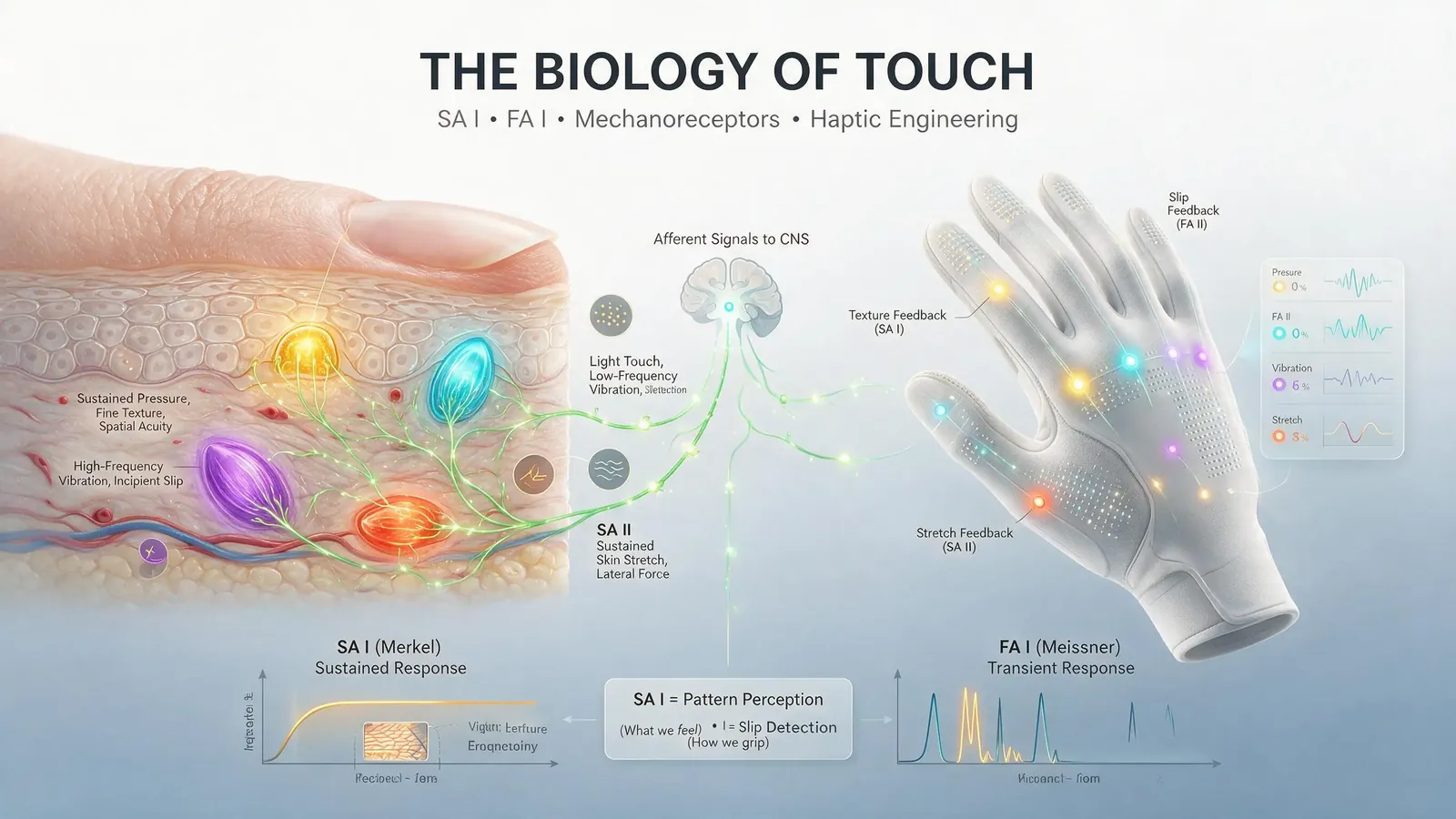
Four mechanoreceptor populations in glabrous skin each handle distinct stimulus properties. Responding intensely to even the slightest physical contact, Meissner corpuscles are particularly attuned to gentle touch and low-frequency vibrations in the skin. Merkel disk complexes handle sustained pressure and fine spatial texture with the spatial acuity that makes fingertip discrimination possible at millimeter scale. High-frequency vibrations, similar to those produced by power tools or during an impending fall, stimulate Pacinian corpuscles. Ruffini sensors are designed to detect sustained skin stretch, a feature often overlooked in traditional haptic system designs that tend to prioritize normal force and vibration over this aspect.
The control-theoretically useful distinction is between Slowly Adapting type I afferents, which drive pattern perception and curvature discrimination and maintain firing during sustained deformation, and Fast Adapting type I afferents, which respond at contact onset and offset and specifically encode the incipient slip between skin and object that triggers the reflex grip force adjustment preventing a held object from sliding. For a surgical haptic system trying to communicate tissue texture during blunt exploration, you are primarily targeting SA I response. For communicating slip at a grasped tissue edge, you need FA I stimulus characteristics, which means dynamic deformation rate matters more than static pressure magnitude.
Haptic perception is divided into two distinct subcategories: cutaneous perception, which involves sensing texture, contact, and slip information through the skin surface, and kinesthetic perception, which detects joint position and the magnitude of applied forces in the musculotendinous system. A complete telehaptic system needs to address both rather than treating force feedback and tactile feedback as interchangeable, which they are not.
Electronic Skin: Multi-Modal Sensing at the Fingertip Scale
Transduction Mechanism Selection
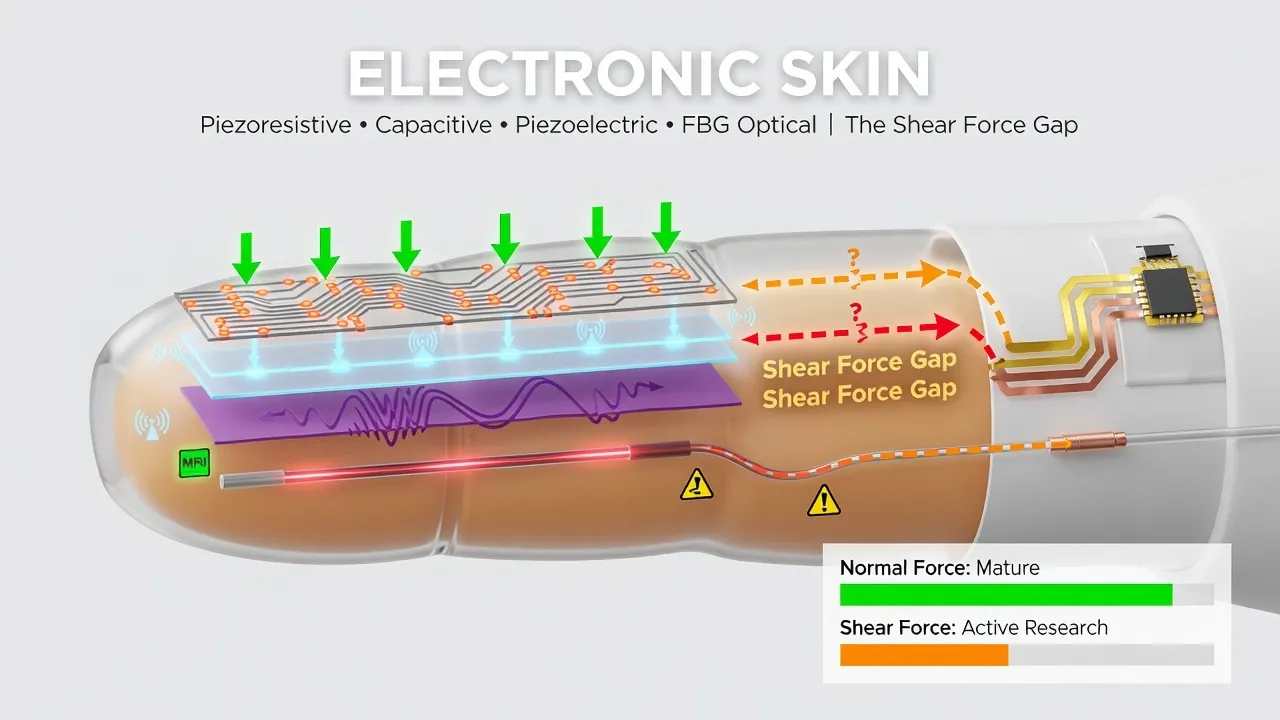
By altering their electrical resistance in response to mechanical stress, piezoresistive sensors can easily be integrated into a variety of flexible substrates and seamlessly connect to standard analog-to-digital converters (ADC) hardware. High sensitivity and a stable static response are well-suited for measuring sustained normal contact forces during tissue manipulation. The limitation relative to other modalities is dynamic range and cross-axis sensitivity: piezoresistive elements tend to show some coupling between normal and shear force inputs, which complicates calibration when both are present simultaneously.
Even the slightest application of force causes a detectable shift in the separation between electrode layers in capacitive sensors, allowing for incredibly accurate measurements of forces at levels as low as a fraction of a millinewton. The practical complication in a medical environment is susceptibility to electromagnetic interference from electrosurgical units and from the power electronics in the robot's own drive system, both of which generate substantial conducted and radiated noise at frequencies that overlap with the capacitive measurement signal bandwidth.
Flexible piezoelectric sensors fabricated from PVDF film excel in applications where high sensitivity is crucial for measuring static forces accurately, while also detecting subtle vibrations with outstanding high-frequency precision. The piezoelectric properties of PVDF film are thoroughly understood across a broad range of frequencies, spanning from below 100 Hz to several kilohertz, encompassing both Meissner and Pacinian receptor frequency ranges. The fundamental limitation is that piezoelectric devices do not measure static forces, only the dynamic component, so they must be combined with a static-response sensor in a hybrid array if both static pressure and vibration need to be measured simultaneously.
By encoding mechanical strain into the wavelength shift of a reflected optical signal, fiber Bragg grating (FBG) optical sensors can detect strain with sensitivities as low as 1 picrometer per microstrain. The critical clinical advantage is complete electromagnetic immunity, since the measurement signal is optical rather than electrical, making FBG sensors directly compatible with MRI-guided surgical environments where any ferromagnetic or conducting sensor would either be hazardous or electrically unusable. The integration challenge is routing fiber optic cables through a robotic wrist structure that bends through large angles during manipulation, without inducing bending-induced loss artifacts in the FBG wavelength reading.
The Shear Force Gap
The honest assessment of where e-skin technology currently falls short is shear force measurement at clinical accuracy. Shear forces, the lateral forces that act parallel to the sensing surface during sliding contact and tissue manipulation, correspond to the skin stretch that Ruffini endings encode and are directly relevant to detecting incipient slip during grasping tasks. Normal force sensing across all four transduction modalities is comparatively mature. Shear force sensing at the precision and spatial density needed for surgical finger-scale tactile displays remains an active research problem rather than a solved one, and this gap is one of the primary reasons current haptic gloves and surgical end-effector tactile arrays still do not fully match the sensory richness that direct finger-tissue contact provides.
Bilateral Control Architecture: Stability Under Delay
The Master-Slave Control Problem
In surgical teleoperation, a master-slave architecture is used, where the operator controls a slave robotic arm through a master device like a haptic arm or gloved interface, which replicates the operator's movements and receives tactile feedback to simulate resistance. The bilateral loop sounds conceptually straightforward and is mechanically difficult.
Any time delay in the communication link between master and slave introduces phase shift in the force feedback signal that can cause the bilateral control loop to go unstable, producing oscillations at the master device that grow rather than damp out, exactly the opposite of what a surgeon needs when their hand is driving a tool near critical vasculature. Simple position-force bilateral controllers can maintain stability only when round-trip delay stays below a few tens of milliseconds; longer delays require architecturally different approaches.
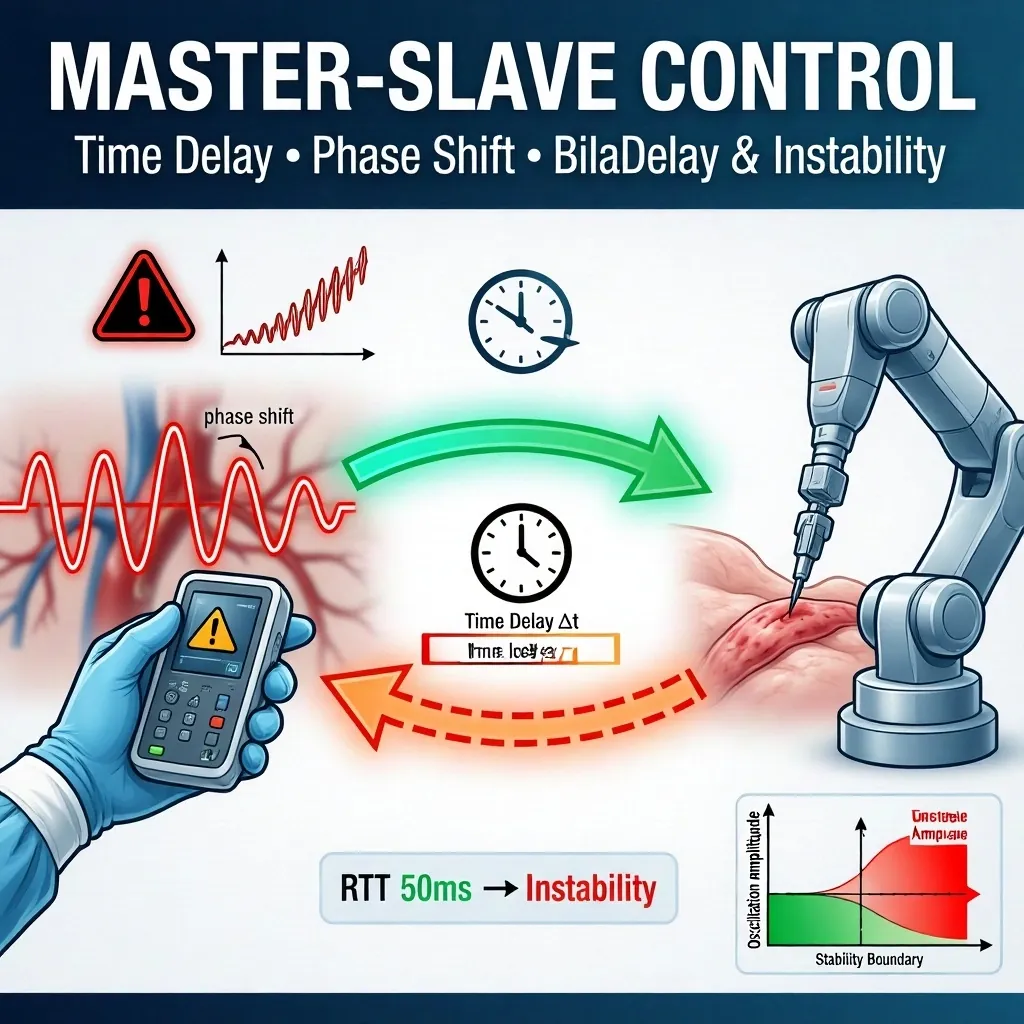 The diagram reveals a critical challenge in teleoperation and haptic feedback: the inherent master-slave control issue. Time delays (Δt) and phase shifts accumulate in the communication loop, degrading system performance. When the round-trip time (RTT) reaches just 50 ms, the system crosses the stability boundary, causing oscillation amplitude to grow uncontrollably into the unstable region. This instability undermines transparency and precision in remote manipulation, making delay compensation and advanced control strategies—such as wave variables or passivity-based approaches—critical for safe and effective telerobotics.
Wave Variables and Passivity
The wave variables formalism addresses bilateral stability under delay by recasting the communication link as a passive transmission line in the Hamiltonian sense. Rather than transmitting position and force signals directly, the controller transforms these into wave variables, scattering-based representations that encode energy flow rather than raw kinematics, before transmitting them. The transmission line's passivity property then guarantees that no energy is generated within the communication channel regardless of delay, which provides an architecture-level stability guarantee rather than a tuning-dependent stability margin. The practical cost is that wave variables formalism introduces a degree of position and force tracking error that degrades transparency, the fidelity of force sensation, even when the system is stable, and managing that transparency-stability trade-off is where most of the bilateral control engineering judgment lives.
Impedance control approaches this from a different angle, imposing a desired dynamic behavior characterized by virtual mass, stiffness, and damping parameters on the robot's end-effector to regulate how it responds to environmental contact forces. Tuning those impedance parameters correctly for a specific surgical task, where the correct stiffness is different for soft organ manipulation versus bony structure navigation, is a control design problem that directly affects both the feel of the system and its safety behavior when unexpected anatomy is contacted.
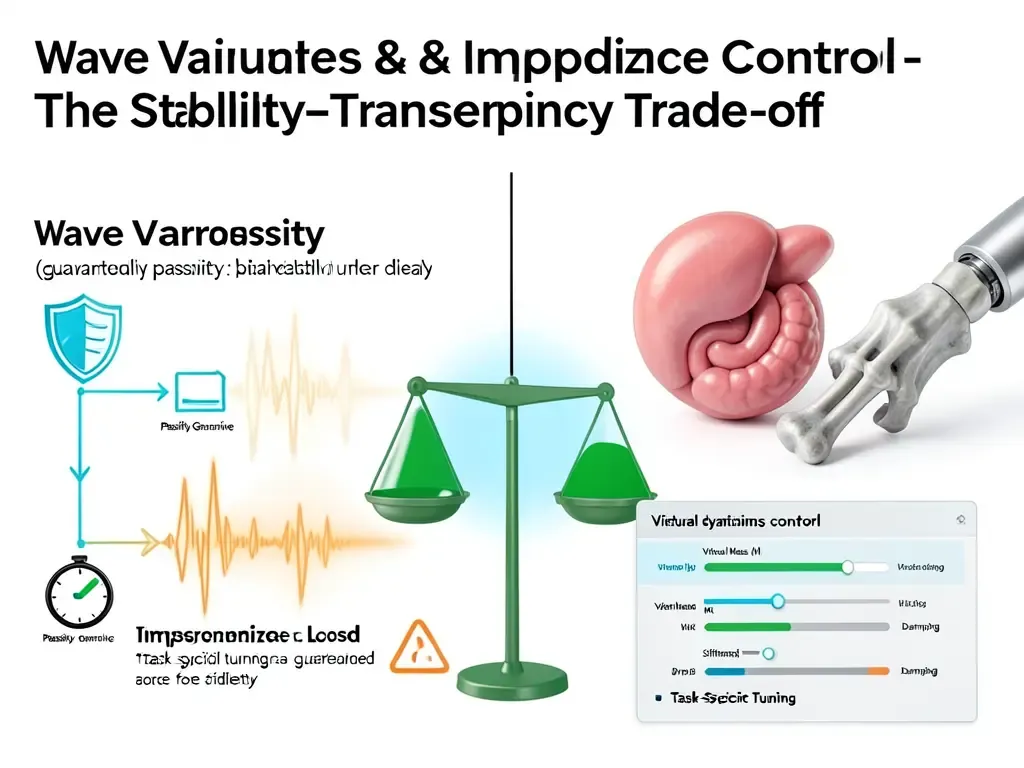 Upon close examination of the diagram, it is evident that maintaining stable operation in a dual-system setup necessitates integrating translucent control systems alongside bilateral teleoperation, which is additionally bolstered by the utilization of wave variables and passivity-based control techniques. By encoding force and velocity into wave signals, the approach guarantees passivity—ensuring stable interaction even with significant time delays. However, this stability comes at the cost of reduced transparency (fidelity of force feedback to the operator). To balance these competing goals, the system employs impedance control with tunable virtual dynamics—adjusting virtual mass, damping, and stiffness parameters. Task-specific tuning of these virtual elements allows engineers to prioritize either robust stability or high-fidelity environmental rendering, depending on the application, such as delicate surgical procedures versus heavy-duty remote manipulation.
Virtual Fixtures and Forbidden Region Enforcement
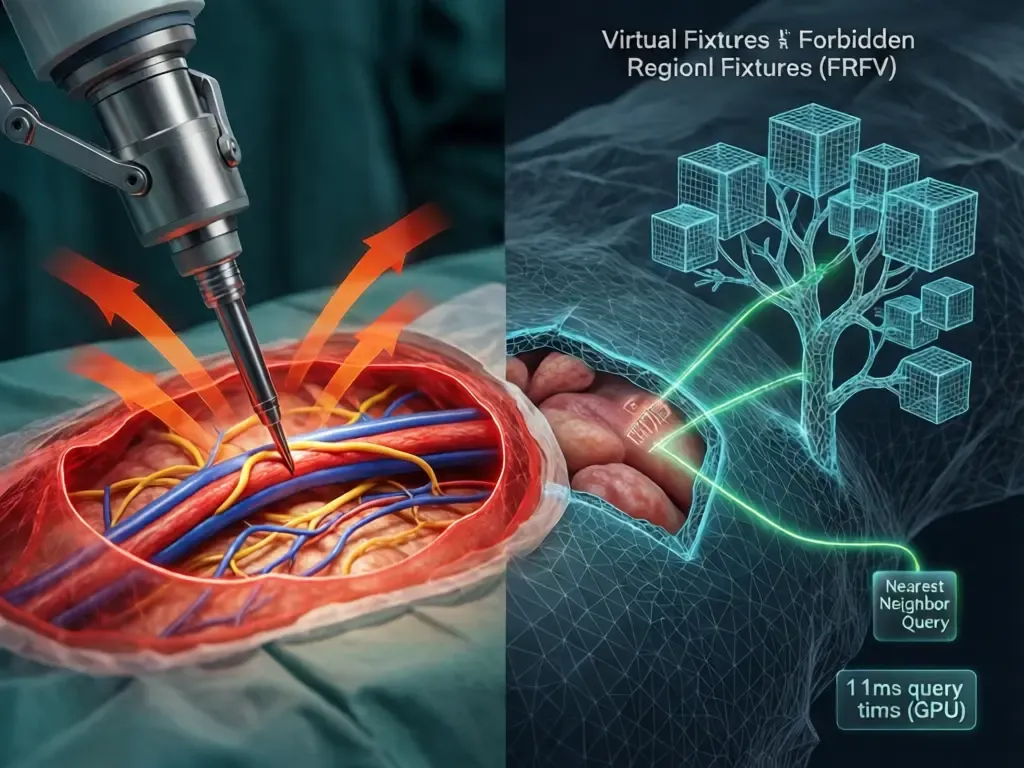
Virtual fixtures are software-generated geometric constraints that influence the robot's motion based on a model of the surgical anatomy. Forbidden Region Virtual Fixtures specifically define no-go volumes around critical structures, major vessels and nerves being the standard use case, and either prevent the robot from entering them or generate an escalating force repulsion as the tool approaches the boundary. Implementing FRVF in real time requires computing the minimum distance between the tool tip and the anatomical mesh surface at the control loop update rate, which is computationally non-trivial when the mesh has high polygon count.
K-d tree spatial partitioning of the anatomical mesh accelerates the nearest-neighbor proximity query substantially compared to brute-force mesh traversal, and GPU-accelerated k-d tree implementations bring the query time into the sub-millisecond range needed for control loop integration even on complex anatomy models. The limiting factor is usually not the spatial query itself but the upstream pipeline: registering the intraoperative anatomy model to the patient's actual position accurately enough that the FRVF boundaries correspond to the real tissue locations rather than a pre-operative model that has shifted with tissue movement.
Thanks to groundbreaking research in cutting-edge tactile technologies, users can immerse themselves in a dazzling array of nuanced sensory experiences.
Force Feedback: The High-Bandwidth Channel
Kinesthetic force feedback from motors or actuators in the master device is the highest-bandwidth haptic channel available for communicating the mechanical response of remote tissue to the surgeon's hand. It is directly proportional to what the operator would feel with an unmediated surgical instrument, modulated only by the transmission losses and impedance mismatches in the bilateral control loop. Meta-analysis of robot-assisted surgery outcomes consistently shows that force feedback reduces the peak tissue contact forces applied during procedures, which correlates directly with lower rates of inadvertent tissue damage and reduced blood loss. The force reduction benefit is largest for inexperienced operators, who are less able to extract force magnitude information from visual tissue deformation cues alone than experienced surgeons who have developed visual-haptic substitution skills over many procedures.
Vibrotactile Feedback: The Wearable Alternative
Vibrotactile actuators, located where the operator's finger or forearm comes into contact with the skin, use controlled vibrations to transmit information instead of relying on direct tactile feedback. The implementation overhead is substantially lower than full kinesthetic force feedback, which requires high-power actuators and rigid exoskeletal structure, making vibrotactile approaches more practical for wearable form factors. The information density is lower: vibrotactile channels encode event timing and relative intensity effectively but convey force magnitude information less accurately than direct force feedback, which limits their application to signaling contact events, slip detection, or threshold crossings rather than continuous force rendering.
Ultrasound Mid-Air Haptics and EDM Beamforming
Ultrasonic phased arrays, the Ultraleap technology being the commercially most visible example, create localized acoustic radiation pressure at focus points in free air by phase-controlling individual transducer elements to cause constructive interference at a target location. The medical education application, where trainees can feel simulated anatomical features without touching a physical model, is the primary near-term clinical use case.
Standard Delay-and-Sum beamforming focuses acoustic energy to a single point but does not control the spatial distribution of the focus region's acoustic pressure profile. Energy Difference Maximization beamforming improves on this by optimizing across the full transducer array to maximize the acoustic energy within a defined target region while simultaneously minimizing it outside that region, producing a sharper focus boundary and better spatial resolution of the tactile sensation. That resolution improvement matters for delivering texture-like stimuli where feature discrimination depends on the spatial separation between adjacent pressure maxima. The safety constraint that the field glosses over less than it should: focus intensities required for perceptible sensation reach 145 dB or above in sound pressure level, and sustained proximity of the focal zone to the ear canal carries hearing risk that system designs have to actively manage through geometric constraints and exposure time limits.
Peripheral Nerve Stimulation for Prosthetics
For prosthetic users, direct peripheral nerve stimulation can restore tactile feedback from the prosthetic hand to the amputee's sensory cortex through the residual nerve endings in the residual limb, bypassing the skin surface entirely. Encoding the appropriate stimulation patterns to produce natural-feeling touch sensations rather than paresthetic tingling is the unresolved challenge, as covered in the broader haptic engineering literature; stimulation parameter encoding that produces genuinely naturalistic sensation rather than abstract electrical feeling remains an active research problem with significant neuromorphic computing interest.
Surgical training systems play a critical role in measuring performance evidence, enabling surgeons to refine their skills and improve patient outcomes.
The da Vinci Research Kit, an open-source research platform built around da Vinci hardware with a ROS2-interfaced control layer, provides the standard research testbed for surgical haptic algorithm development, allowing custom bilateral control schemes and virtual fixture implementations to be tested on the same hardware platform clinical systems use. Similar to Prosit, simulation platforms such as these utilize software tools like Unity3D or Blender to create realistic, physics-based tissue models and force feedback rendering, allowing for precise training in procedure-specific manipulation skills before actual surgery on live patients.
Color-coded visual feedback, tools that shift from green to yellow to red as they approach a forbidden region boundary, combined with increasing force repulsion from the virtual fixture, proves effective in training studies for accelerating the novice-to-competent transition. Expert surgeons benefit less from this guidance specifically because they have already internalized the anatomical map and the visual cues that substitute for haptic information during operation; adding explicit constraint visualization to an expert workflow can actually slow experienced operators by adding cognitive burden rather than reducing uncertainty.
The core principle of the Tactile Internet lies in its pioneering application of haptic feedback, fundamentally transforming the way humans interact with computers through a multisensory experience that appeals to both cognitive and kinesthetic processing.
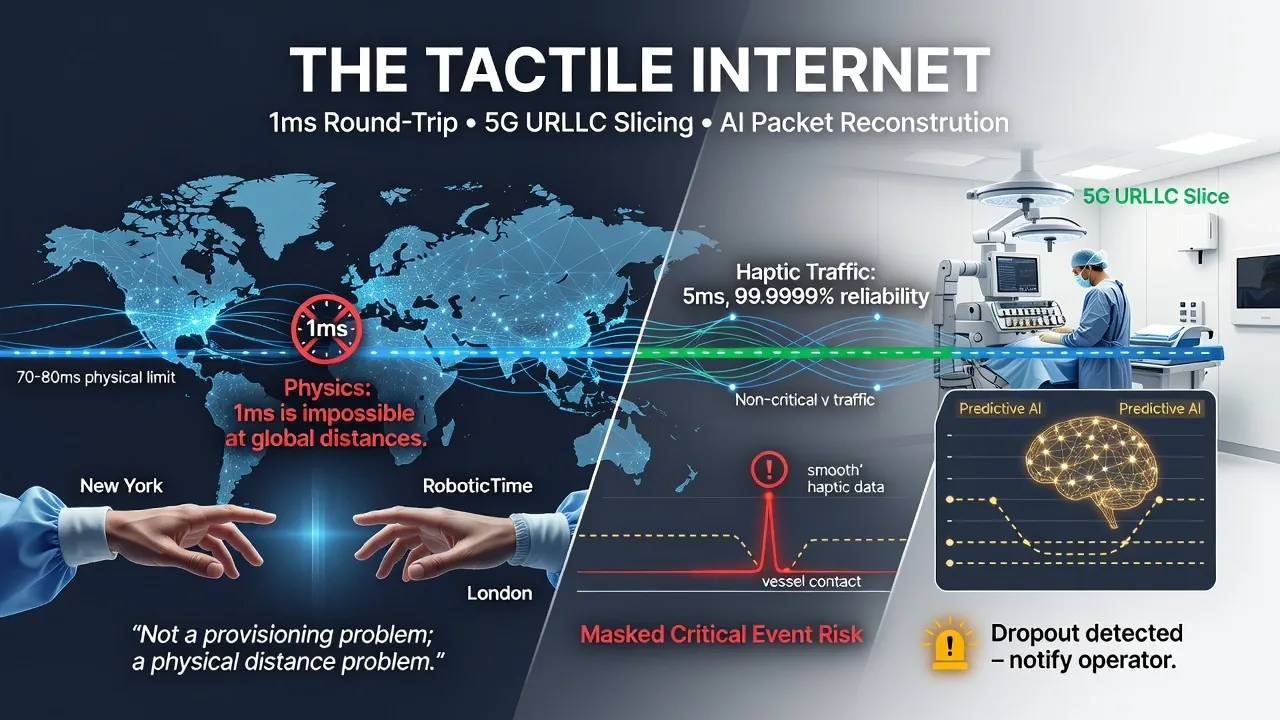
The communication latency requirement for transparent haptic teleoperation is qualitatively more demanding than what general network data transfer or even video streaming requires. Round-trip latency below roughly 1 millisecond is the threshold commonly cited for haptic data exchange to feel perceptually synchronous, based on the temporal resolution of kinesthetic feedback integration in the sensorimotor system. For reference, current trans-Atlantic fiber optic round-trip times run around 70 to 80 milliseconds at the physical propagation limit, which means genuinely transparent remote surgical haptics is not a network provisioning problem; it is a physical distance problem that edge computing and regional infrastructure can partially mitigate but cannot fully overcome for globally distributed surgery.
The 5G Ultra-Reliable Low-Latency network slicing solution is particularly well-suited to the local deployment scenario, where a hospital's private 5G network can be provisioned with dedicated slices that offer sub-millisecond latency and nearly 100% reliability for haptic traffic, taking priority over general-purpose data traffic sharing the same frequency band. That local network performance, combined with predictive AI models that estimate missing or late-arriving haptic data packets from the recent force signal trajectory, is the practical architecture that makes robust haptic teleoperation viable over real wireless hospital networks where occasional packet loss is unavoidable.
Deep learning-based haptic data reconstruction addresses packet loss specifically by treating the force signal as a time series with predictable dynamics given the task context, and training models to generate plausible missing data segments that maintain the perceptual continuity of the haptic experience even when the network drops packets. The engineering trade-off is that the predicted force signal diverges from the actual remote force signal during the dropout period, and a task-critical event, a vessel contact or a tissue tear, occurring precisely during a dropout interval could be masked by the prediction filling in a locally smooth extrapolation. That failure mode has real clinical implications that the system design must account for through appropriate dropout detection and operator alerting.
Benchmarking and Standardization: Haptify and Beyond
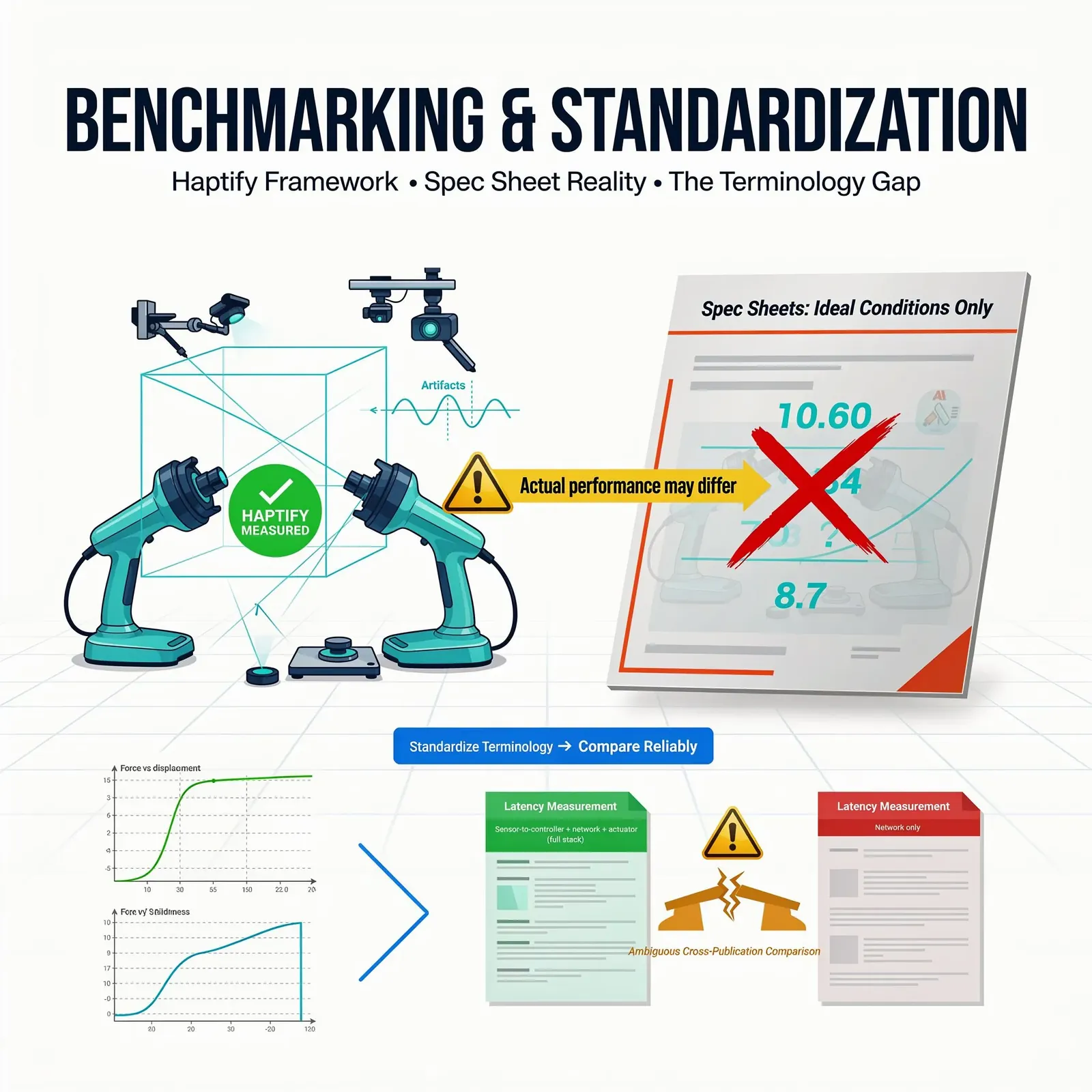
Haptify provides a measurement-based benchmarking framework for grounded force-feedback devices that moves device comparison from manufacturer specifications to objectively measured performance on standardized tests: workspace characterization, free-space vibration artifacts, stiffness rendering quality across the device's force output range, and force bandwidth. Comparing the 3D Systems Touch and Touch X, both widely used in surgical simulation, against each other and against emerging research devices on a common Haptify measurement protocol gives medical institutions a basis for procurement decisions that device spec sheets cannot provide, because spec sheets measure ideal behavior under optimal conditions while Haptify measures actual behavior under standardized test conditions.
The pressing standardization gap beyond device characterization is terminology and test protocol alignment across research groups. A haptic system "latency" measurement in one publication may include sensor-to-controller processing, network round-trip, and actuator settling time, while another publication measures only the network segment. Until the research community agrees on what each benchmark quantity includes in its measurement scope, cross-publication comparisons remain ambiguous regardless of how carefully individual studies are conducted.
Where This Field Actually Needs to Go
Hardware robustness is the translation bottleneck that delays clinical adoption more than algorithm maturity. Flexible e-skin sensors that demonstrate excellent performance in a laboratory setting frequently degrade under the cyclic mechanical strain of repeated glove donning and doffing, and standard autoclave sterilization cycles that maintain sterility in clinical environments are particularly destructive to the polymer substrate interfaces, conductive trace adhesion, and any encapsulant that protects electronics from moisture. A haptic sensor array that cannot survive 50 sterilization cycles while maintaining calibrated accuracy is a research demonstrator, not a clinical tool.
Multimodal integration beyond normal force and vibration toward simultaneous shear force, temperature, and humidity sensing requires sensor array architecture choices that current e-skin designs have not converged on, and the signal processing overhead of simultaneously reading, demultiplexing, and interpreting multiple transduction modalities at clinical update rates adds embedded systems complexity that existing sensor readout ASICs are not fully optimized for. Despite progress in multiple dimensions, the industry remains hindered by the lack of a single clinical-grade fingertip sensor that can withstand repeated sterilization while matching the sensitivity of direct finger contact.
As the current decade draws to a close, the medical robotics sector is bracing itself for a revolutionary metamorphosis, driven by breakthroughs in haptic technology that promise to unlock fresh frontiers.